Adapted from Trauma-Responsive Pedagogy by Arlène Casimir and Courtney Baker
I would be remiss if I did not also discuss how challenging it can feel at times and what teachers can do to navigate that challenge. The first truth of the student–teacher relationship is that the burden falls on the shoulders of the adult, even when this may feel unfair or unrewarding (Howard et al. 2020). At the same time, it is also true that students cannot meet educators’ emotional needs (Howard et al. 2020). Teachers are humans, too, with their own relationship and attachment history. Teachers who are burned out or experience secondary traumatic stress show up to school with an “empty cup” and are less able to fill the cups of their students. It is much harder to avoid taking things personally, especially in the context of relationships, when you are exhausted, short-fused, on edge, checked out, or worn down. The third and final truth is that teaching demands the full self (Howard et al. 2020). It would not be so hard or hurt so much if educators did not care.
It is not a matter of if the work will affect educators but rather when. When you consider it this way, at least some experience of teacher stress, and possibly burnout or secondary traumatic stress as well, is inevitable in your career. Compounding this issue, many schools are ill equipped to provide the supports you need to navigate through that challenge. For example, many schools lack resources, making it a struggle every day to get the most basic elements of your job done. Others are associated with high levels of staff turnover and student mobility, which inherently trigger educators’ own defensive reactions to investing in new relationships. Still others perpetuate systemic racism and oppression by attempting to control students’ bodies rather than support their cognitive, emotional, and behavioral growth. Teachers in unsupportive schools may feel like boats adrift on a stormy sea, unable to dedicate scarce personal resources to the work of teaching and building resilience.
Taking these truths and their associated challenges together, it is clear that teachers must prioritize self-care. Finding ways to “fill your own cup,” recover from burnout, cope effectively with experiences of secondary traumatic stress, and surround yourself with personal and professional supports is as critically important to your professional success as your other tasks as an educator. In other words, the theories covered at the beginning of this section also applied to teachers: educators must find ways in their professional lives to balance risk with resilience.
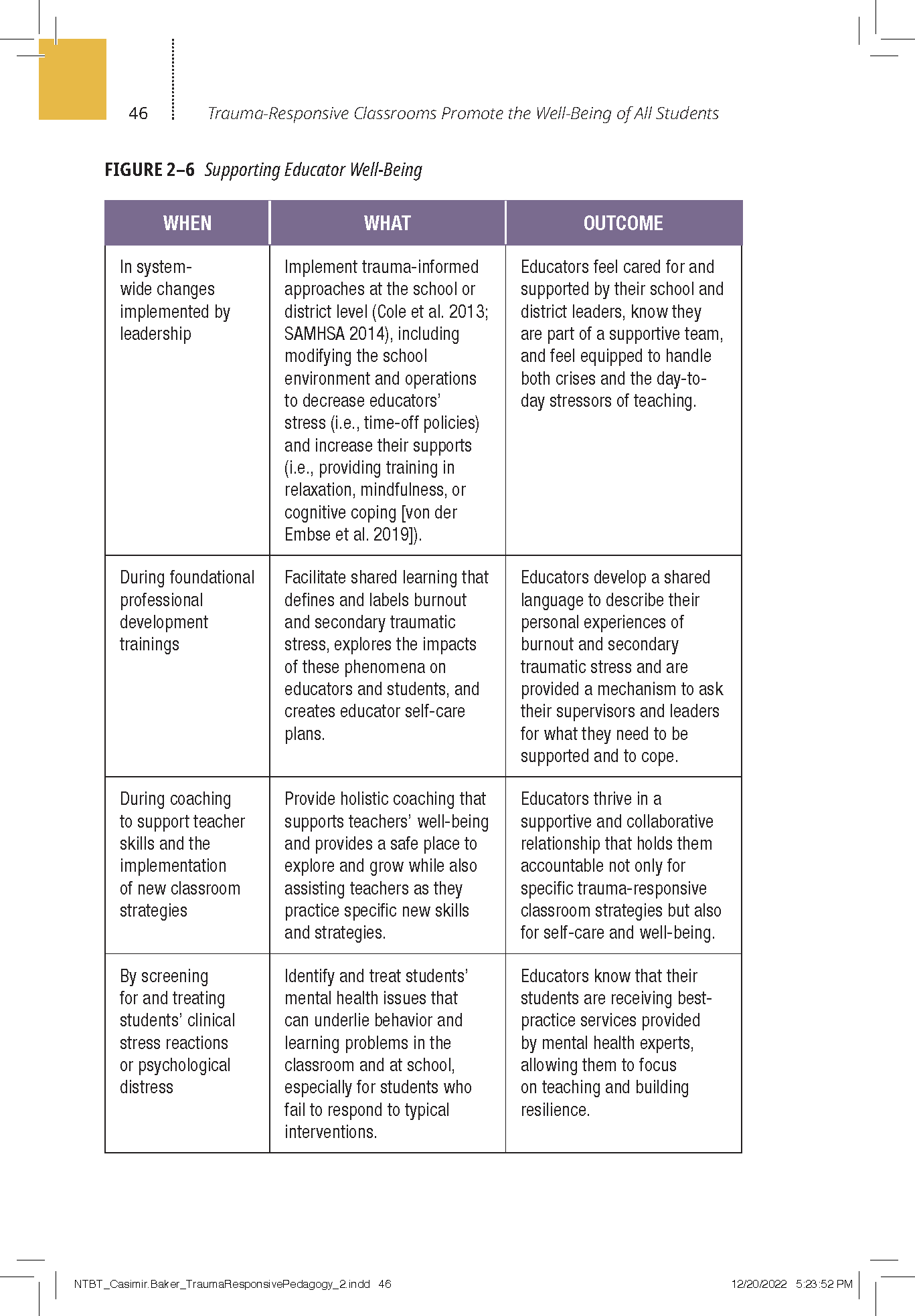
Although there are numerous excellent resources to support educators trying to tackle this challenge (e.g., Herman and Reinke [2014]; von der Embse et al. [2019]), it is not sustainable for individual teachers to maintain their wellness in a broken system. Ironically, even schools committed to trauma-responsive education may struggle to support teacher well-being. For example, having too few resources and perceiving student needs as being too acute stands in the way of effective implementation of trauma-responsive teaching (Wittich et al. 2020), actually becoming another source of teacher stress and potential burnout rather than a support. Even when supervisors, coaches, and leaders realize the importance of supporting educators, they struggle to translate that knowledge into action (Baker et al. 2018). Nonetheless, with careful implementation, trauma-informed approaches prioritize the well-being of everyone in the school building, including both the educators and the students. Teachers may also opt to organize study groups (see Herman and Reinke [2014] for additional guidance) or advocate for improved work conditions with their leadership. Some examples of what a school-wide commitment to educator wellness might look like, organized by the four pillars of trauma-responsive education, are described in Figure 2–6 (below).