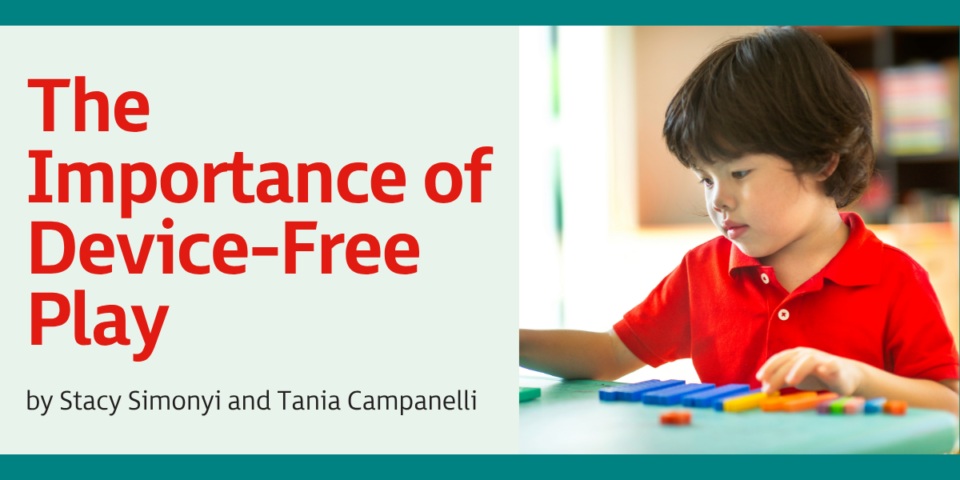
By Stacy Simonyi & Tania Campanelli, authors of Positive Classroom Communities.
Play IS Social Emotional Learning (SEL)
“Play is the work of the child.” This famous line, and its many variations, is most often attributed to Maria Montessori, Jean Piaget, and Fred Rogers. Three pioneers and advocates for play-based learning. In their eras, play was creative and collaborative, using open-ended materials and each other to build imaginative worlds while problem-solving and working together. Today, screens (computers, tablets, and video games) have largely replaced that type of play and have permeated childhood (both in and out of the classroom). In our screen-based culture, new apps and websites have shifted children’s play away from the physical realm, where students connect and learn with one another, toward isolated, individual interactions with devices. Social and emotional skills developed during unplugged play make learning easier; screen-based play makes it harder.
Device-Free Play
In a screen-based culture, digital devices have become, for most children, a familiar language. Screen-based play is attention-grabbing. And educational technology has often promoted screen-based play as necessary for children to build their tech skills. But as many educators and caregivers are now noticing, this type of play has negatively affected students’ ability to focus and attend to learning, regulate their emotions, and build relationships with their peers.
If we want our students to develop these skills, we must consider and implement device-free play.
Device-free play can be child-led or adult-guided. Often called “free play,” child-led play offers opportunities for children to decide what to play with, how to play, who to play with, and when they want to stop. It is unstructured. While adults may limit the materials and space available, they don’t provide instructions for the play. Instead, children create the “rules of the game,” whether that's a literal game they invent or limits they set for themselves in an activity. For example, children playing “the floor is lava” decide amongst themselves what the boundaries are and which areas of the room and pieces of furniture are considered “safe zones”. Adult-guided play, on the other hand, is when the teacher sets the rules for the play, often with a specific learning objective or goal in mind. One way adult-guided play might be used is through setting up activities which prompt students to use certain materials to develop a deeper understanding of a concept. For example, in a 4th grade classroom, a teacher has students explore how red and white water beads move through plastic tubing, setting up for a discussion about the circulatory system. Both types of play support social and emotional growth, offering different opportunities for skill development.
While it might be enticing to move play to screens for the limited amount of unstructured time we may have available in our classrooms (such as creating online quiz games or following dances through videos), if we want to help students learn the skills they need to connect with themselves and each other, we need to offer opportunities for children to play offline.
SEL Benefits of Device-Free Play in the Classroom
While adding device-free play to your already packed teaching schedule may feel daunting, it offers many benefits. Here are some ways in which play builds social and emotional skills aligned with the CASEL components and subcomponents identified in Positive Classroom Communities.
- Identity. Through play, children learn about themselves, including their interests and strengths.
- Self-Efficacy. Play builds confidence. Because play doesn’t have a grade or evaluation, children often take risks and practice tasks without worry of success or failure.
- Coping strategies & managing emotions. Play organically and authentically creates opportunities for children to experience frustration when the unexpected happens–a game is lost, a block tower falls, a puzzle is challenging to solve. They experience big emotions and need to find ways to cope in order to resume play. This helps students develop emotional resilience and self-regulation skills.
- Goal Setting. While often not explicit, children set and manage goals during play. As their play evolves, so, too, do their goals. For example, a student might want to build a castle out of magnet tiles, but after realizing there aren’t enough to reach that goal, the child shifts to making a house.
Social Awareness:
- Belonging. Through play, children learn from the different social groups in the classroom. They might belong to one group if they are engaged in physical play or organized sport, but a different group when they engage in constructive play or imaginative play. Each group has different social norms, and play helps children learn the social skills needed for each one. They also learn they don’t always have to play with the same group and that belonging isn’t restrictive.
- Recognizing strengths in others. Through play, children can see the diverse interests that their peers have, and notice others’ strengths. One peer might be artistically creative, another might be good at jigsaw puzzles, and another fast on the soccer field. Play is a way to recognize and celebrate others’ strengths.
Relationship Skills:
- Communication. Through play, children learn about ways to share ideas and listen to the ideas of their peers to reach a goal. Device-free play also allows for face-to-face interactions where children can identify how nonverbal language and tone are part of communication.
- Conflict Management. Conflict is part of play. As adults, we shy away from experiences that might involve conflict; however, children need to experience small disagreements through play to learn how to move from conflict to problem-solving and collaboration.
Responsible Decision-Making Skills:
- Critical Thinking. Through play children can test theories through experimentation, connect ideas, deepen their understanding of concepts learned in the classroom, and engage in the creative process. Play is a way that children can think through complex problems in a fun and engaging way–it is the ultimate vehicle for building critical thinking!
- Understanding the Effects of Personal Behavior. Embedded within play are natural consequences that help children learn the necessary skills to build perseverance, resilience, and cooperation with others (to name a few). For example, students learn there are consequences for saying unkind, hurtful things such as not being invited into future play activities or games.
Make it Intentional
Play is often one of the first things that is cut out of a school day or only included as a reward for good behavior at the end of the day or even week. However, making play intentional as part of your school day is more beneficial for children’s social and emotional health and wellness than an every-so-often activity.
We know that finding the time might sound impossible with all of the demands on us teachers, however doing so doesn’t have to be onerous.
You might start by setting aside time at the beginning of the day. This is what Tania does. Every morning when students arrive, they have 15 to 20 minutes of device-free, child-guided play. She sets up stations with various materials (Uno, Magnetiles, Legos, cardboard, fabrics, glue, buttons, etc.) and students can move around the room and play at their leisure. Over the years, she has seen the benefits as this play time allows students to start their day in a creative and interactive way and once academic lessons begin, students are more present and ready to learn. Tania also ends each day with 10 minutes of circle games, which includes playing games like Poison Dart Frog or Orchestra Chef.
You might also consider offering adult-guided play as part of your curriculum, adding in activities that build students’ background knowledge or allow students to get hands-on experience about a concept as part of your teaching.
It does not matter what you specifically offer as choices, as long as you are intentionally implementing this device-free play time into your schedule and that you explicitly explain to students the benefits of device-free play. Even 10 minutes can make all the difference!
For more play-based SEL activities, check out Positive Classroom Communities!