Adapted from Positive Classroom Communities by Stacy Simonyi and Tania Campanelli.
Coping strategies help us manage big emotions. They are typically enjoyable activities that allow us to self-soothe when we feel anger, grief, or anxiety. Effective coping strategies are different for each person because everyone experiences emotions differently in their bodies. In addition, coping strategies may vary by culture and age, and we can learn from each other in this way. Some healthy coping strategies might include sensory experiences, distraction, or movement activities. Some may be reflective (like journaling or mindfulness practice), or about seeking social support (talking to a friend or a trusted adult).
It is important for children to gather a variety of ways to deal with stress or big emotions. The following lessons can be done in any order; however, it is recommended that all three lessons take place within a one-to-two-week time frame.
ACTIVITY 1: Move Your Body
- Talk with students about the importance of movement. “What kinds of activities are movement activities? Why are movement activities important—what do they do for our bodies?” Share with students that movement activities are also good for our minds. “When we move our bodies in healthy ways, our brain produces good-for-us chemicals that help us focus and be in a good mood. Movement is a great way to help our energy levels—if we have high energy, movement helps us relax; if we have low energy, it helps us wake up. It also helps us regulate our bodies when our bodies or minds feel out of control. For these reasons, movement is a great coping strategy—a way to help us manage our emotions.”
- Tell students they’ll be learning a series of quick movement activities and then will reflect on how the activities help their bodies and emotions and which might be helpful for them as coping strategies. Students will try out four different types of movement activities:
- Moving outside or around the gym (this can include running, moving in a wheelchair, etc.)
- Choreographed dancing (how-to dance videos are great; just make sure all children are able to do the suggested movements as you are choosing them)
- Free dancing to music (you might have students vote on a song they’d like to listen to)
- Roll the Dice Exercises
- On the board, write out numbers 1–6 and then come up with fun movements for each number (for example, number 1 can be jumping jacks, number 2 can be act like a chicken, number 3 might be close your eyes and touch your nose, and so on).
- Roll the dice
- Students do whatever action corresponds to the number that was rolled
- Repeat for as long as you’d like to play
- After completing all the activities, students will reflect on the experience. Have students discuss: “Which activities might be good to use as a coping strategy when you have a big reaction to an emotion? How did you feel before the movement activities? How about after? We talked about movement being good for your body and mind—based on how you are feeling now, can you think of any other ways movement can help us?”
ACTIVITY 2: Listen and Paint
- Lead a discussion with students about mindfulness or being present in the moment. Talk with children about how sometimes our minds wander, and we start thinking about what we are going to do later, or what we did last night, or what happened at recess. But there are ways that we can bring our minds back to focusing on what’s happening right in front of us.
- Tell students that they will be listening to three different types of songs. You will play each song twice, and they will create a piece of artwork (drawing or painting) for each song to express any emotions or feelings that the songs evoke.
- Play the ballad you chose and encourage students to focus on the lyrics as they draw or paint. As students are creating their artwork, ask them to focus on what they hear and how they feel as they listen. After playing the song twice through, reflect on the experience. “Was there a lyric that stood out to you? What did you draw or paint? How did it align with the song? How did you feel as the song was being played?”
- Repeat using the song without a narrative and the fully instrumental song.
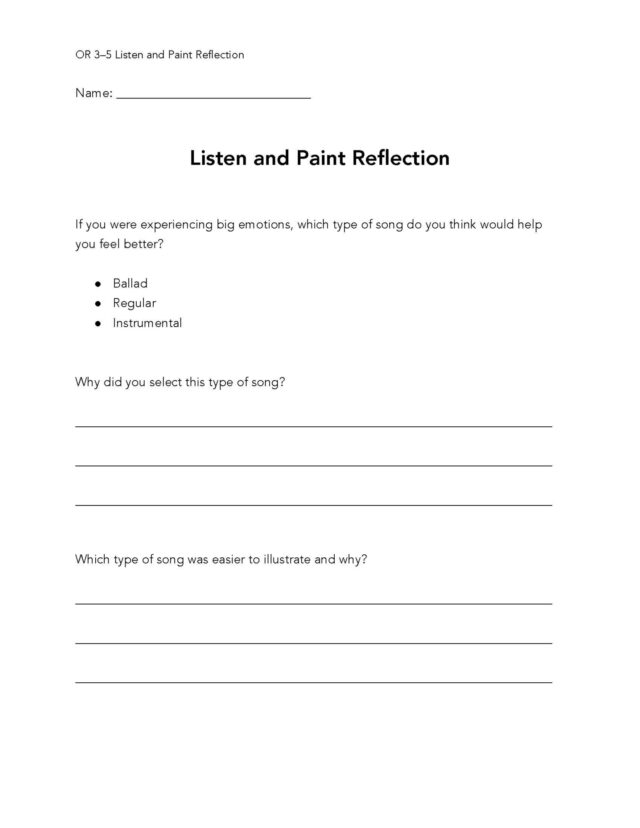
When all three songs are finished, have students reflect on the experience using the Listen and Paint Reflection (download the image below!) or as a whole-class discussion. “How did you feel while doing this activity? What were you thinking about? Were some songs easier to draw to than others? Did you notice that you were coloring faster or harder with some songs while other songs you were coloring slower and lighter? What do you notice about the artwork you created for each song? Why do you think they were different? How can you use this activity if you are having big feelings— what might this activity help with?”
ACTIVITY 3: Exploring Textures
- Explain that there will be three stations with different types of materials for students to explore. In small groups, students will rotate through the stations, spending ten minutes at each one. They will then reflect on each activity.
- As students engage with the materials at the stations, observe and give positive feedback.
- “I notice that the loose parts table is coming up with some creative ideas using the small pieces. I see that Courtney has created a jellyfish out of marbles, fabric pieces, and gems. She is focused, which tells me her body is calm, and her brain is in a creative state. Over at the play dough table I see that Leonardo is taking deep breaths as he kneads the dough. That tells me the play dough is helping him regulate his breathing.”
- As you walk around you might also help students mindfully use the materials by prompting deep breaths or asking guiding questions about how they are feeling as they complete the activities.
- Once students have visited each station, have them reflect upon the activity. When you regather as a whole group, ask students to discuss how the activity went. “Which activities might be good to use as a coping strategy when you have a big reaction to an emotion? How did you feel before the stations? How about after?”