Digital Literacy Is a Teaching Expectation
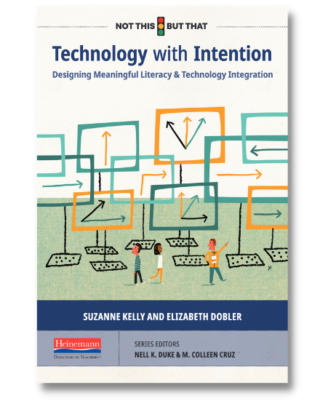
The following is from Technology with Intention by Suzanne Kelly and Elizabeth Dobler.
What’s most essential for teachers’ understanding is that technology plays an increasingly larger role in the ways we find and use information. It’s not a question of if we use technology to teach reading and writing, but how we use technology to create the foundation for children to become literate adults. To function in today’s world, students must learn print-based and digital literacy skills simultaneously. Nimbly moving from print to digital and back is a must for reading textbooks, library resources, news, and novels because these can be read on paper, an e-reader, a cell phone, or a computer. Links within the texts can lead to websites, videos, and/or podcasts, requiring the reader to determine quality of the sources and to comprehend information in different formats. However, many teachers are in the difficult transition period of figuring out what digital literacy should look like.
General Expectations for Literacy Instruction and Technology
- The International Literacy Association calls for literacy instruction that prepares students to “produce, communicate, interpret, and socialize with peers” (2018, 2) in both digital and nondigital ways.
- The Common Core English Language Arts Standards (National Governors Association and Council of Chief State School Officers 2010) present expectations for integrating digital technologies into literacy instruction, promoting the notion that being literate and being digitally literate are synonymous (Dalton 2012) and calling on students to
- integrate and evaluate content presented in diverse media and formats, including visually and quantitatively, as well as in words
- use technology, including the internet, to produce and publish writing and to interact and collaborate with others
- gather relevant information from multiple print and digital sources, assess the credibility and accuracy of each source, and integrate the information while avoiding plagiarism.
- Although the standards do not specify how digital literacy skills should be taught, these expectations form a foundation for English language arts instruction in K–12 schools that necessitates technology being an integral part of the curriculum, not just an add-on. Technology should help students learn in ways not otherwise achieved—faster, more easily, with more depth. If technology merely replicates the ways we already learn, then it becomes a very expensive substitute for paper, pencil, and flash cards.
Becoming adept at the process of gathering information about ourselves and the world around us and communicating it with others are at the heart of literacy learning. If we think about this process, as adults, it’s easy to see the ways technology makes literacy possible for us on a daily, hourly, and even moment-by-moment basis. Developing literacy skills needs to include technology to prepare our students for the traditional and digital literacy experiences they encounter each day.