Educators everywhere share a common goal: helping every student become a confident, capable reader and writer. Achieving this requires more than isolated strategies—it calls for a comprehensive approach to literacy instruction, one that integrates foundational skills, knowledge-building, writing, assessment, and professional learning into a cohesive system.
This blog is the first in a series exploring each essential component of comprehensive literacy instruction. We begin with phonemic awareness.
What Is Phonemic Awareness?
Phonemic awareness is the ability to hear, identify, and manipulate the smallest units of sound, phonemes, in spoken words.
Unlike phonics, which connects sounds to letters, phonemic awareness is purely auditory. It enables students to:
- Blend sounds to form words (e.g., /c/ /a/ /t/ → cat).
- Segment words into individual sounds (dog → /d/ /o/ /g/).
- Substitute phonemes to create new words (cat → bat).
- Recognize rhymes and syllables, playing with sound patterns in language.
These skills are foundational for decoding, spelling, and ultimately, reading comprehension.
Why Phonemic Awareness Matters
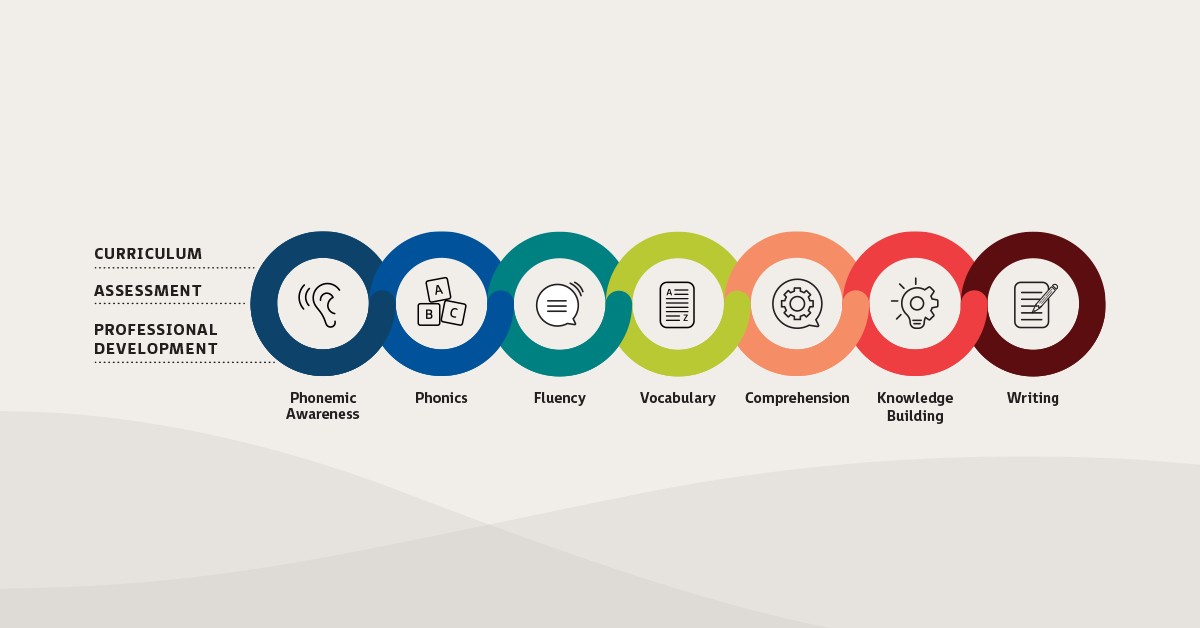
A comprehensive literacy approach recognizes phonemic awareness as one of seven interconnected components: phonemic awareness, phonics, fluency, vocabulary, comprehension, knowledge building, and writing. These components work together to create a balanced, responsive framework for literacy learning.
Why does incorporating phonemic awareness matter?
- Balanced Instruction: Phonemic awareness complements phonics, vocabulary, and comprehension rather than standing alone.
- Differentiation: A comprehensive framework allows educators to tailor instruction for diverse learners.
- Greater Impact: Integrating phonemic awareness with other components accelerates reading development and builds confidence.
When phonemic awareness is taught in isolation, students may master sound play but fail to transfer those skills to decoding and comprehension. Integration ensures that early gains lead to lasting literacy success.
Understanding the Research Foundations
Decades of research confirm the importance of phonemic awareness:
- NICHD (2000): The National Reading Panel identified phonemic awareness as a strong predictor of later reading success.
- Dehaene (2009): Neuroscience research shows phonemic awareness activates neural pathways essential for connecting sounds to letters.
- Ehri (2014): Orthographic mapping—the process that enables students to store words in long-term memory—relies heavily on phonemic awareness.
In short: phonemic awareness is not just an early skill; it’s a neurological prerequisite for fluent reading.
Instructional Strategies for Building Phonemic Awareness
Effective instruction is explicit, systematic, and engaging. Consider incorporating:
- Daily Practice: Short, frequent activities such as oral blending, segmentation, and sound games.
- Manipulatives: Letter tiles, counters, or physical movements (clapping, tapping) to make sounds concrete.
- Songs and Rhymes: Music, poetry, and chants to reinforce patterns and rhythm.
- Small-Group Instruction: Targeted support for students who need additional scaffolding.
- Progress Monitoring: Frequent formative assessments to guide instructional decisions.
Recommended resources include decodable texts, structured lessons, and shared reading programs such as Jump Rope Readers, Moonlit Mountain Readers, and Saxon Reading Foundations, enabling teachers opportunities to connect phonemic awareness activities to text.
Classroom Applications for Phonemic Awareness
Phonemic awareness becomes most effective when woven into daily routines:
- Morning Meetings: Quick blending or rhyming warm-ups.
- Literacy Centers: Rotating stations focused on segmenting, blending, and manipulating sounds.
- Read-Alouds: Highlight rhymes, alliteration, and sound patterns during shared reading.
- Peer Collaboration: Sound-based games that strengthen academic and social skills.
Teachers consistently observe that students who engage in regular phonemic awareness activities become more flexible, accurate, and enthusiastic readers.
Connecting Phonemic Awareness to the Rest of Literacy Learning
Phonemic awareness is the gateway to phonics, where students learn to connect sounds with letters and spelling patterns. As students master sound manipulation, they become stronger decoders and encoders, which in turn expands vocabulary and deepens comprehension. Writing reinforces these skills, while ongoing assessment ensures instruction remains responsive.
The incorporation of professional learning is essential to a comprehensive approach to literacy. Educators need sustained support, coaching, and access to research-based strategies to effectively teach phonemic awareness, as well as to integrate literacy instruction with data-driven differentiation.
Practical Tips for Educators
To make phonemic awareness instruction both effective and engaging, consider these practical strategies for your classroom:
- Make it playful: Games, movement, and music keep students engaged.
- Differentiate activities: Scaffold tasks to support a range of learners.
- Integrate instruction: Connect phonemic awareness to reading, writing, and vocabulary lessons.
- Assess frequently: Use quick checks to track growth and adjust instruction.
- Collaborate: Share strategies and challenges through professional learning communities.
Phonemic awareness is more than an entry point into literacy, it’s a foundation upon which reading and writing are built. When embedded within a comprehensive approach to literacy instruction, it equips every student with the tools they need to thrive.
Recommended Resources for Phonemic Awareness Instruction
Heinemann offers research-based tools that integrate seamlessly with core instruction and support phonemic awareness development:
- Jump Rope Readers
A decodable text series designed for early readers. These books provide controlled vocabulary and phonics-aligned content, allowing students to apply phonemic awareness skills in authentic reading experiences. - Moonlit Mountain Readers
A collection of engaging decodable texts featuring rich illustrations and varied genres. Perfect for reinforcing sound-letter relationships while maintaining student interest. - Saxon Reading Foundations
A structured program aligned to the Science of Reading. Saxon offers explicit, systematic lessons in phonemic awareness and phonics, making it ideal for Tier 1, Tier 2, and intervention settings. - Shared Reading Collections
Interactive read-aloud experiences that highlight rhymes, alliteration, and sound patterns. Shared reading fosters oral language development and reinforces phonemic awareness in a collaborative setting. - The Reading Strategies Book
A comprehensive resource offering practical strategies for differentiating instruction and supporting foundational skills, including phonemic awareness, within a broader literacy framework. Units of Study in Reading
An inquiry-based curriculum designed to build strong readers through integrated instruction. Units of Study connects phonemic awareness to reading and writing development across grade levels.
Some of these resources provide explicit instruction whereas others offer meaningful practice, ensuring phonemic awareness is not taught in isolation but as part of a comprehensive literacy framework.
How Heinemann Supports a Comprehensive Approach to Literacy
For over 40 years, Heinemann has partnered with educators to deliver research-based literacy resources that reflect the realities of the classroom. Rather than offering one-size-fits-all programs, Heinemann provides inquiry-based, differentiated resources that align to specific goals.
By supporting every facet of literacy, and every educator delivering literacy instruction, we help schools move toward more intentional and effective literacy outcomes.
***
Ready to strengthen your literacy instruction? Download our free ebook, Establishing Effective Instruction through a Comprehensive Approach to Literacy, and explore how you can build a more impactful, student-centered literacy program. Or watch the edLeader Panel with scholars Carol Jago, Lorna Simmons, and Dr. JT Torres for a conversation exploring how foundational literacy skills, strategic fluency development, and deep comprehension work in harmony to empower confident, lifelong readers.
Learn more about Heinemann's literacy resources.
Learn about establishing effective instruction with a comprehensive approach to literacy.