by Kristina Peterson
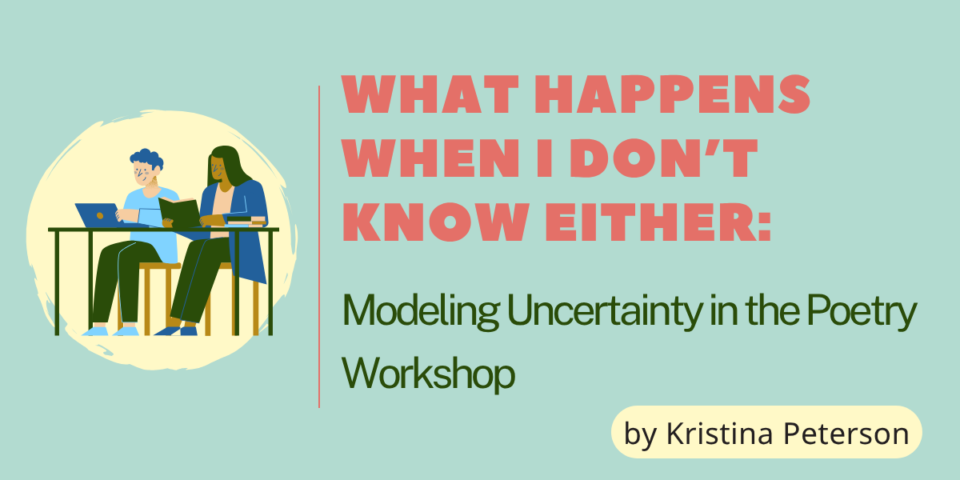
There's no moment in my teaching year that makes me more uncomfortable than the one where I sit down in front of my students, open my notebook, turn on my document camera, and try to write a poem.
I cross things out. I second guess my word choice. I write a metaphor and then stare at it wondering if it's actually a simile. Sometimes I say out loud “I don't love this yet, but I'm going to keep going and see where it leads me.” Or I might say “I have no idea if this is even working,” and something shifts in the room. Shoulders loosen. Pens begin to move. The student in the back corner who's been staring out my window for the last 10 minutes finally writes her first line.
That moment when uncertainty gives them permission to write is one of the most important things I do all year. And it took me over a decade to understand why.
Students have been so thoroughly trained to be correct that they've lost access to productive struggle. They only raise their hands when they're certain of the answer. When given open-ended choices about what to write, they freeze, or gravitate towards the safest possible topic. And when we introduce a new unit, the first question they ask is: how will this be graded?
Their questions make sense. Uncertainty gets you the wrong answer. The wrong answer gets you a bad grade. And a bad grade means you aren't good enough. Many students develop finally tuned systems for minimizing exposure: answer questions only when certain, write only what feels safe, don’t risk anything real.
Poetry cannot be written inside that system. Poetry requires the willingness to write when you’re not sure where you're going. So before I can teach them to write poetry I have to teach them how to stick with it when there’s no right answer.
When I write in front of my students, I narrate my uncertainty: I keep coming back to this image of playing cards with my grandfather at the kitchen table, but I don't know what it means yet. Or, This line about parenting felt right when I wrote it last week, but now I am not sure where I was going. I want students to see that writing is a process of not knowing and trying anyway.
Teenagers nowadays need proof of that. They’ve heard teachers say there are no wrong answers here for years, and most of them don’t believe it because the evidence of their schooling suggests otherwise. But watching their teacher genuinely struggle in front of them tells them something no rubric ever could: their uncertainty might actually be a sign that they’re doing it right.
The Day the Workshop Ran Without Me
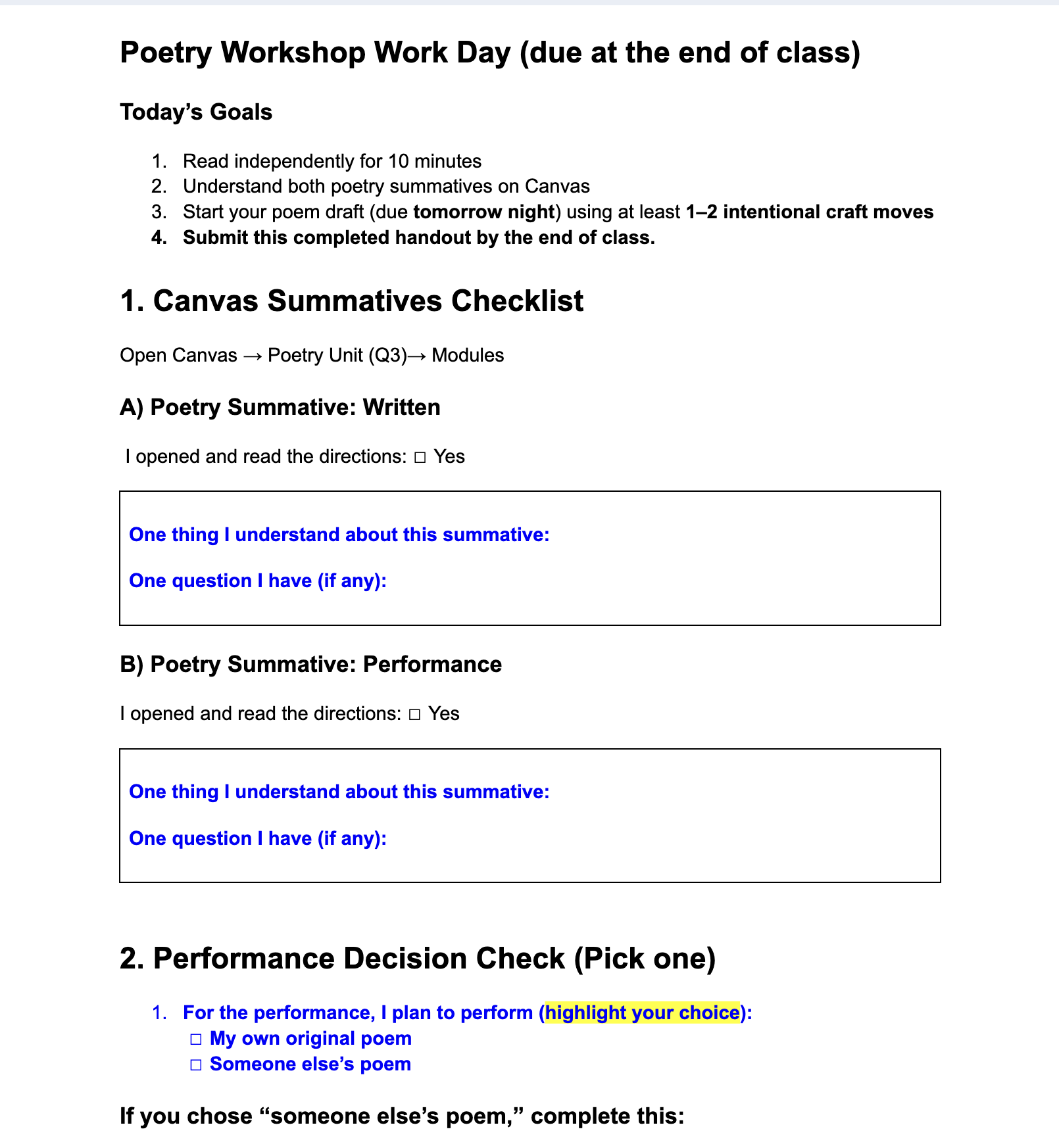
Last month, I had to be out unexpectedly during one of the most critical weeks of our poetry unit. Students were moving from quickwrites to a draft. With snow day interruptions, Winter Carnival schedule changes, and February break looming, I could not lose any momentum. So I did something I’ve been doing a lot more lately: I prompted AI (my new favorite planning tool is Claude) to build a sub plan, specifically a structured work day handout that could hold the class in my absence.
My prompt: I'm a 9th grade English teacher running a poetry writing workshop. Students have spent three weeks reading contemporary poetry collections, doing daily quickwrites, and writing alongside mentor texts. I need a structured handout a substitute can distribute without teaching anything. Students are expected to move through it independently.
The handout should:
- Open with 10 minutes of independent reading
- Guide students to review both summative assignments on Canvas, recording one thing they understand and one question they have about each
- Ask students to decide whether they'll perform their own poem or someone else's for the performance summative
- Send students back to their notebooks to identify their strongest draft
- Offer a concrete craft move menu so students have some direction
- Ask students to set one revision goal and answer a few short reflection questions
The tone should be warm and direct and assume students are capable. Include a deadline reminder at the bottom (tomorrow). Use numbered sections, checkboxes for decisions, and enough white space that it doesn't feel overwhelming. Don’t make assumptions about this task, ask questions if needed.
My revised handout is linked here. Claude did a pretty great job following my directions and I only needed to make a few tweaks. When I came back and read through the completed handouts, the answers told me everything about where my students actually were, not where I hoped they were, or assumed they were, but where they actually were. Some needed more time. Some asked for a conference. Several needed reassurance that their topic was enough. And a significant number of them wrote some version of the same two things: I want to know how this will be graded and I want to know what the best craft moves are.
The Grading Question Isn’t Really About Grading
When students ask about grading it’s often a request for certainty in a space that is asking them to tolerate uncertainty. The grading question is a way of saying tell me the rules so I know how to be safe. The craft move question is a way of saying tell me the right answer so I don't have to risk the wrong one.
Here is the truth about craft moves: there aren't better or worse ones, there are only intentional ones. A poem built entirely on repetition can be quite devastating. So can a poem with no repetition at all. The question shouldn’t be which craft move should I use? The question writers should be asking is: what am I trying to say and what structure might help me say it? That's a question only the writer can answer. And answering it requires exactly the kind of productive uncertainty that the rubric question is trying to avoid.
What I’ve started doing, partly because of what I read in those sub plan handouts, is addressing the grading question directly and early and then redirecting it. Yes, here is the rubric. Yes, here is what I'm looking for. And now: set it aside. Because the poem we write while trying to satisfy a rubric is almost never the poem worth writing. The poem worth writing comes from the place you weren't sure you were allowed to go. The rubric is there to honor that poem once it exists. It's not there to tell you how to write it.
What I Want for Them
I want my students to raise their hand when they're uncertain
Not just when they're sure.
I want my students to choose the harder topic,
the one that surprised them
when it shows up in their notebook
three times in two weeks.
I want them to try a structure they've never tried
and not know if it'll work
but try anyway.
I want them to ask more questions
and perform fewer answers.
I really want that to be a better poem, but writing a decent poem isn’t my point. My point is that none of this happens by accident. It happens because the classroom has been built, slowly, and deliberately, into a place where not knowing is allowed. Where the teacher sits down with a notebook and a bad first line and says “I have no idea where this is going yet. Let's try anyways.”
That's the model. And there is never a moment where I struggle more genuinely than when I'm writing poetry in front of my students. Which means there is never a more important moment for them to watch.

Kristina Peterson has been teaching high school English since 2008. She has a master’s degree in teaching and serves the educational community as a new teacher mentor and the Secretary of the New Hampshire Council of Teachers of English. She also teaches in the University of New Hampshire’s Writers Academy and Learning Through Teaching program. She is an Ambassador to the award-winning Arts in Action program through NH's Racial Unity Team, and cofounder of Bookshelf Diversity, a statewide grant project that provides diverse books to New Hampshire classrooms. She is the co-author of AI in the Writing Workshop.